Continuing my search and formulation of my heritage follows on from
I discovered that I have ancestry from the beginning of the colonization of the Cape, South Africa, by the Dutch East India Company in the seventeenth Century. Obviously it starts centuries before but I hadn’t realized my roots in South Africa started at it’s conception. Many are the threads that join our heritage together from distant places and through different circumstances. The telling of the story will unfold over time in my own way. This post is an artistic, metaphoric expression of my thoughts. I use the term ‘eight great grandmothers’ as a symbolic average of how many generations there were from this time in my family history in South Africa. It is approximately 213 women from my mother’s side who cradle the descendants to my generation. Needless to say I am not going to write about them all, just the ones that are notable to me.
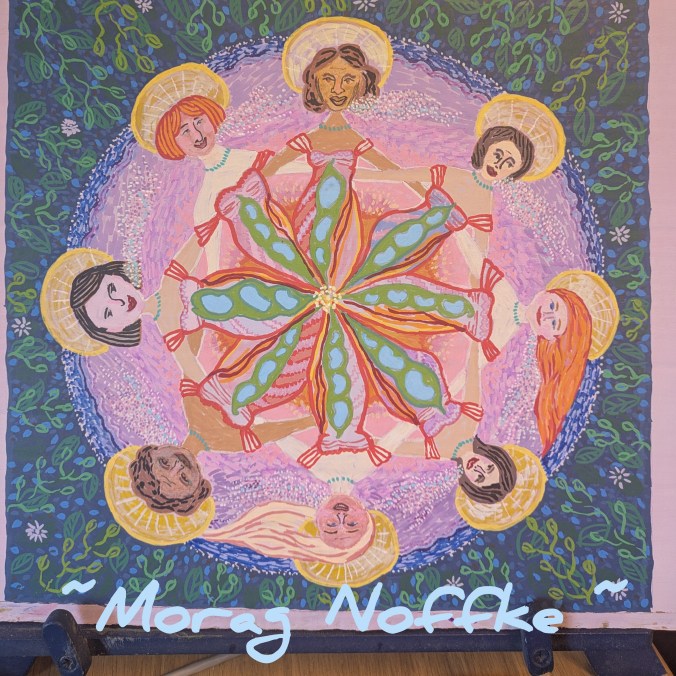
Matriarchy Mandala

Eight great grandmothers
From different lands
Enslaver and enslaved
Each bringing their
Culture
Each leaving people
Behind
Each giving up
Treasured ways.
Eight Great Grandmothers
contributing DNA from
Far and wide
Each were loved
by some
Each were despised
By others.
Each woman lived under a canopy of stars sharing the same sun and moon. Each lived off the earth. They came from afar, over the oceans, by ship. How many wanted to go? And how many wanted to stay – we don’t know. They were the enslaver, the enslaved, the pioneer and the indigenous people all brought together under unnatural circumstances. Their souls made contact, their words touched; they sang their songs and danced their dances. They might have mingled under duress. They are our Sacred Matriarchy, each to be honoured for what they brought us. Different people, on the same land, women held the land together.
Description of the Matriarchy Mandala, 30cm x 30cm
Materials
Recycled cardboard,
Acrylic wall paint as primer,
ENMY pens,
And Caran d’ Ache wax crayon water colours.
Image description
Mandala means circle in Sanskrit. My use of the term ‘mandala’ is not how it is used in Buddhism or Hinduism, although it is a circle. In a nutshell the original word mandala is a sacred image symbolizing the universe, wholeness and spirituality. It is created with coloured sand poured out meticulously to create the image. It is an ephemeral image that slowly blows away in the breeze over time.
I use the term mandala as my images use a circle too but I incorporate the influences of my studies in psychology where the late Karl Jung advocated making mandalas for one’s mental health. I have amalgamated the idea of using the mandala in an unconventional way but expressing my concepts of my soul’s grappling. I consider my mandalas to be personally sacred as I work through concepts and difficult issues, assimilating and synthesizing my thoughts and expressing them as an image which has deep personal meaning.
The style of this mandala is Naïve. As we look at The Matriarchy Mandala we instantly see the heads of each woman, with a halos, which forms a circle; each has a trail emitted from their mouths. These women are dancing in unison, whirling in time to the music while they sing. Their bodies are not clearly obvious, rather the central area looks like two squares overlaid at right angles, forming eight points. At second glance their bodies can be seen but they are rendered in a very flat manner with very little use of perspective or shading. This causes the image to morph into one area, the flat background and foreground creates a confusing image but if the viewer looks closely one can see the form of bodies, arms; and beans overlaid on top of the bodies; behind them is a fiery image. The viewer might be able to see that the bodies form a flower image. Their arms look more like sticks than shapely arms. Behind their shoulders is the rising and setting sun that reaches over the sea into the night. Lastly we see the edges of the painting forming another square; holding all earths’ vegetation. These women share space with each other receiving the same gifts of water, fire, air and earth even although they might not choose to be together.
The execution of the image
The image came to me over the months, starting in April when I was reading about the history of the East India companies, slave trading and digging into my ancestry. I knew I wanted use a mandala image and an old image of women I had done as a mandala previously came to mind; although they were not holding hands. I also wanted to incorporate the bean image as a symbol of fertility. So the image emerged slowly as I researched over time; like developing a photograph the old fashioned way: gradually the image emerges. Lastly, it all came together when I participated in the aqua ceilidh. That’s when I decided that the women should be holding hands in a dance.
My struggle: I struggled with their faces as at first they looked as flat as their bodies. I wanted them to be more realistic than I could manage with the acrylic pens. I was nervous to tinker around with the faces in case I messed up and spoiled what I had. Sometimes we settle for less because of this type of fear. This is a typical reaction for any creative person and I think it is like being pushed passed ones comfort zone. I decided to try using Caran d’ Ache wax crayon water colours. At first I really thought I had messed up but I realized there was no turning back. I thought to myself, ‘I’ve don’t it now, I have nothing to lose.’ In the end I am happier with the faces as they are now compared to the original faces. They depict more reality but still keep the naïve charm.
Symbols discussed
Starting at the center we see the circular image of the anthers holding the pollen symbolizing the seeds that are dispersed out into the world like the diaspora moving out into the world. Next are the petals of the cosmos flower which symbolizes peace, order and balance. Kosmos in Greek means harmonious universe. This is what I wish for, in an ideal world we would be at peace in unity.
The squares symbolize stability as in North, South, West and East and also divine order. The points of the squares also symbolize the women coming from far ends of the earth. The four corners can also symbolize earth, fire, water and air which is echoed in other images in the mandala. The squares form an architectural feeling reminiscent of temples and altars. In the Christian culture our bodies are the temple of the Spirit. What I would hope for is that we would treat each other as sacred beings worthy of respect and compassion but the irony is that at this time in history there was no unity and harmony: it was each company or country or person for themselves.
The flat image: causing a confusion, is in juxtaposition to the squares symbolizing stability and order. These two opposite qualities of confusion and stability and order are intentionally depicted that way to stir up a uneasy feeling of dissidence that I imagine would be part of this society. I wish that there would be peace, balance and order but I am aware that there was disharmony and discontent.
Now let’s go to the center again and look at image of the women. They form the cosmos flower of peace and they dance together, holding hands. Their heads, as mentioned above, are more prominent than the rest of their bodies, it is here one sees their individuality. I found it quite symbolic that I struggled to capture the unique features of each woman; depicting how the memory of them has been lost in time. The red of their dresses symbolize deep passion for life, love and the fire of life while the trickle of dark red ribbon-ties symbolize the blood shed in the name of avarice and greed. Overlaid on each figure is a bean pod with individual beans inside symbolizing their fertility and the DNA passed down through the generations. The beans look like little embryos waiting to be born. My personal thoughts about this culture is that the women nurture while men think of war, domination and subjugation. (I know this is a generalization) but while women embroidered lives together men planned genocides for their own gain. We are tempted or driven by greed or avarice no matter what gender we are.
The fire behind them and the sun rise/sunset reoccurred day after day, as they perform their roles, both enslaver and enslaved. Beyond the fire and the sky is the ocean and water which, in psychology, symbolize emotions and the unconscious, where they are buried deep; things that are unspoken. The ocean also symbolizes that the diaspora came from across the oceans to start again.
The arms and hands form the structure (also shapes the square, while their heads form the circle.) Circle of life in art is used for unity, wholeness, balance, infinity and the cycle of birth, life and death. Yet in this age the circle is is broken in disrespect and dishonoring of other humans by using them in slavery.
The halos depict an inner radiance, or a sacredness that all mothers hold as they care for their families; it also symbolizes a spiritual awakening that I wish they had but we do not know what was in their hearts.
The necklaces are green for growth and healing yet the irony is that while there were many women who wore shackles and rags, the wealthy wore the necklace as a symbol of their refined wealth.
The fire, earth, water and air: these symbols are found in the fire bursting forth from behind them, the earth, both in the bean pods and the foliage; air: the ‘bubbles/dots’ of songs and words coming from each woman; and the ocean which is encircled behind the women.
Irony is used to portray an ideal world or a world we would wish for in retrospect; as we the viewers, would have hoped for. The cosmos flower, the women holding hands, the square shapes, the halos, and necklaces in particular represent the hope for a positive, perfect world while we are still aware of the pain, suffering and the millions of deaths that occurred. We must not pretend it didn’t happen or that the wealth trap doesn’t exist today.
In conclusion
Maybe my image seems whimsical and reflects wishful thinking but let’s take a moment to consider these women giving up their families and land by choice or by force and how these women symbolize the struggle women went through in these times. Was it worth it? Wealth gained at the expense of slavery; at the expense of lives? We will all have our own answers to these questions.
As I have tried to express my thoughts in this mandala the image becomes an important physical tribute that might say more than words can be expressed from my (our) heart(s). I found the process of this mandala very enriching, satisfying and rewarding. When I make my art, whatever I am mulling through, becomes part of my processing. My desire for unity, peace and compassion is evident in the symbols; as is the evidence of history that still needs recognizing. The image becomes my teacher as well as my voice. I hope this image is both personal and also universal in that we can all experience and relate to some of these issues; we all hunger after peace and unity on earth; we all impart emotional baggage and compassion; we all are tempted by or succumb to greed and we all have dark sinister turmoils buried under the ocean of emotions in our unconsciousness. It is up to us how we choose to live now.
I hope – it was more than just interesting – and that you find the Peace and Light that creates order and balance your life.
This is part of my first draft of Discovering my Ancestry, Morag Noffke


Absolutely beautiful, Morag. Both the poem and the mandala are amazing. I’m impressed with all you put into this, and I appreciate the description of your process and what you were trying to achieve. Mission accomplished! 🙂
I love the individuality you gave each face, yet they are all interconnected, one flowing into the other. Fantastic work, my friend!
LikeLiked by 3 people
Thank you, Richard, for your appreciation it means a lot to me. I appreciate you contributing your reflection too … Have a great weekend 🙏✨
LikeLiked by 1 person
This is wonderful, Morag! I love the painting and all that it represents. You have put a lot of thought into this one. It is such a great way to represent ancestory!
LikeLiked by 3 people
Thank you, Dwight 😊 I appreciate your reflection and your kind comment.
LikeLiked by 1 person
You are very welcome!
LikeLiked by 1 person
This is so creative and personal. You must have an inspired muse smiling over your shoulder, well done!
LikeLiked by 2 people
😂 thank you
LikeLike
I love that you are honoring your past by making art. Well done!
LikeLiked by 1 person
Thank you 🙏
LikeLiked by 1 person
ps: I forwarded your blog post to a South African friend who also makes beautiful works of art…
LikeLiked by 1 person
Oh wow, thank you, you are kind. That’s very interesting.
LikeLiked by 1 person
My goodness, you’ve put so much thought, effort, and research into this! After reading about the journey and struggles behind it, who could call the image whimsical? What impressed me most was your beautiful use of mandala art, along with the insightful brief you provided about it. You truly deserve all the kudos for this wonderful piece of work!🙏💐💗
LikeLiked by 1 person
Oh Thank you Kaushal, for your encouraging response. You are right it’s not whimsical, thank you for pointing that out. I am touched by your generous comment. Discussing Art, metaphor and design are some of my favourite topics.🙏💞🌺
LikeLiked by 1 person
It’s truly my pleasure, Morag. You’re more than welcome 🙏💐💗
LikeLiked by 1 person